
Quick Answer: Rotational and night shift workers should judge an apartment by how it behaves at 10 a.m., not 10 p.m. A top-floor unit with interior-facing windows usually beats a larger one parked next to the gate. Tour at the hour you would normally be asleep, and ask what sits above and beside the unit.
Your neighbor's vacuum at 11 a.m. is the enemy. Rotational and night shift workers in Houston's Energy Corridor keep a sleep schedule the rest of the building ignores, and the wrong unit costs two hours of rest a day, every day. The gated studio apartments at The Passages at Rye 1255 sit on Highway 6 near hospitals and industrial employers that run around the clock, so the unit you pick matters as much as the drive home.
What rotational and night shift workers should look for in an apartment
Start with the unit's position, not the finishes. A top-floor unit with windows facing the interior of the property removes the two loudest daytime problems: footsteps overhead and traffic outside. After that, check how close the unit sits to the gate and the laundry room. Both run hardest between 9 a.m. and 3 p.m., which is exactly when you are trying to sleep.
Apartments amenities that matter when your bedtime is 8 a.m.
NIOSH tells shift-working nurses to make the bedroom very dark and quiet, and to stop light coming in under the doorway. Turn that into a rental checklist and it gets short. Does the unit have air conditioning you control? Can you hang blackout curtains without damaging the frame?
The community amenity list for The Passages at Rye 1255 shows air conditioning, hardwood floors, a gated entrance, and an on-site laundry facility. Hardwood also carries footsteps from the unit above better than carpet does, which is worth raising before you take a middle floor.
Reading a quiet neighborhood before you sign
A 1974 EPA analysis, still posted in the agency's public archive, identified 45 decibels indoors as the level that keeps noise from interfering with sleep and conversation. No leasing agent will quote you a decibel figure. Your own ears will do.
Highway 6 is a working arterial road, and the traffic on it does not pause for your schedule. Drive the surrounding streets and neighborhood map at 1 p.m. on a weekday, then again at 6 p.m. If a quiet neighborhood only sounds quiet during an evening tour, you have not tested the hours that matter to you.
How do shift workers compare units for daytime sleep?
The Bureau of Labor Statistics reported that 16 percent of wage and salary workers usually worked a non-daytime schedule in 2017 and 2018, including 4 percent on nights. That is a lot of people sleeping against the grain of their own building. Two units in the same property can be worlds apart at noon, and the difference is position rather than price.
| Unit factor | What it does to daytime sleep | What to ask the office |
|---|---|---|
| Top floor | No footsteps overhead, but more summer heat load | Which available units are top floor |
| Ground floor near the gate | Car doors and the gate motor peak at midday | How far the unit sits from the entrance |
| Windows facing Highway 6 | Steady road hum all day, loudest at both rush hours | Whether an interior-facing unit is open |
| Wall shared with laundry or a stairwell | Machine cycles and door slams travel straight through | What is on the other side of every wall |
| Hard flooring in the unit above | Footfall carries further than it would over carpet | Whether the lease sets a floor covering rule upstairs |
| Best combination for day sleepers | Top floor, facing the courtyard, away from the gate | Can I tour this unit at 10 a.m. on a weekday |
What to check when apartments near me results all look alike
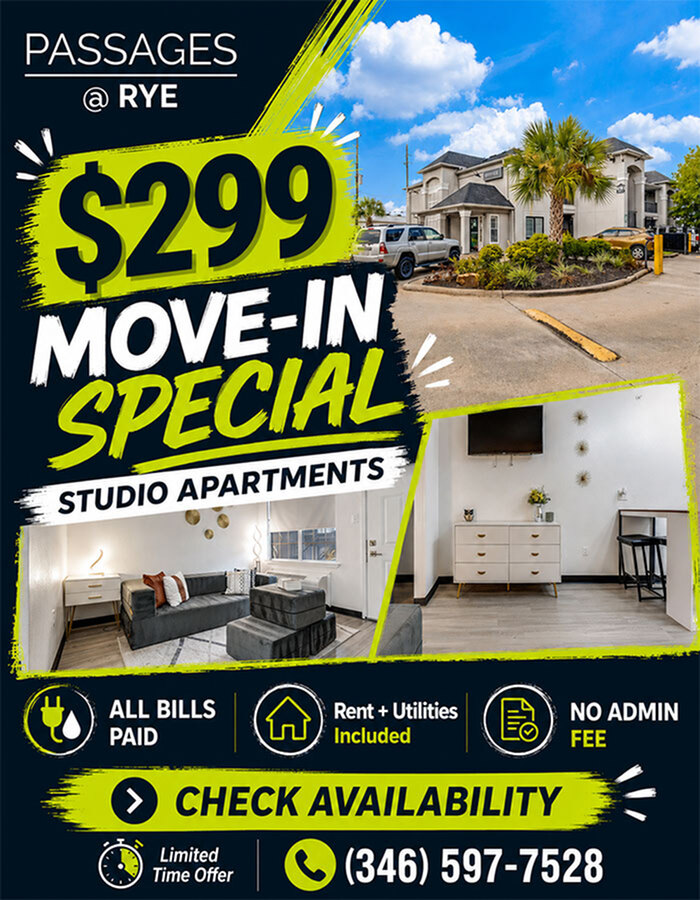
Listing photos get shot in the same flattering hour, so apartments near me searches hide the one variable a day sleeper cares about. Filter on what you cannot change after move-in. As of August 2026, the studio floor plans and pricing page lists three layouts between 236 and 297 square feet, running $715 to $959 a month, with several units open in each plan. When two units share a layout, you have room to ask for the quieter one.
Do soundproofing panels work in a rental?
Mostly not the way people hope. The foam soundproofing panels sold online absorb echo inside a room, which flatters a podcast recording and does almost nothing about a neighbor's television through a shared wall. Blocking sound between units takes mass and sealed gaps. Foam has neither.
What actually helps costs less than the panels do. A loaded bookcase against a shared wall adds mass. Heavy curtains cut some window noise and give you the darkness NIOSH recommends at the same time. For the rest, NIOSH points shift workers toward earplugs or a fan to cover the sounds you cannot remove.
Getting close to a noise proof bedroom door when there is no bedroom door
A studio has no interior bedroom door, so the entry door does all the work. A noise proof bedroom door in a rental is really a sealed door: adhesive foam weatherstripping around the frame and a removable sweep along the bottom. Air gaps leak sound the way they leak heat. Check the lease before anything adhesive touches paint.
Apartment building amenities that help or hurt daytime sleep
A gated entrance cuts through-traffic, which helps you. The gate motor cycling every time a car arrives does not. Judge apartment building amenities by when they get used, not by how they read on a brochure. An on-site laundry facility is a gift at 2 a.m. and a problem at 11 a.m. if your wall backs onto it. Then ask two boring questions: which day landscaping crews come, and what time trash pickup runs.
Frequently Asked Questions
1. What should rotational and night shift workers ask before signing a lease?
Four questions separate a good day-sleeping unit from a bad one:
- Which available units are on the top floor, and which face the interior of the property?
- What sits on the other side of each wall, including laundry rooms and stairwells?
- What day and time do landscaping crews and trash pickup come through?
- Can I see this unit at 10 a.m. on a weekday?
2. Are independent living apartments a good option for someone working nights?
Usually not, and the category is worth clearing up. Independent living apartments are age-restricted housing for older adults, organized around daytime dining and activity schedules. Senior living apartments cover the same market. The Passages at Rye 1255 is market-rate studio housing open to qualified adult renters. Different product entirely.
3. Do blackout curtains really matter if I sleep during the day?
Yes. NIOSH tells night and evening shift workers to make the sleeping area dark enough that you cannot see your hand in front of your face, and it warns that blinds let too much daylight filter through the slats. Opaque coverings work better. Block the gap under the door too.
4. Is a top-floor or ground-floor unit better for day sleepers?
Top floor wins most of the time. Nobody walks above you, and you sit further from car doors in the parking rows. The tradeoff is heat, since top floors take more sun through a Houston August. Ask how the unit's air conditioning handled last summer before you commit.
5. What if the unit turns out to be noisy after I move in?
Raise it with the leasing office early rather than saving it for renewal. Transfers depend on what is vacant and on your lease terms, so nothing is promised. Keep a log with dates and times, since a specific record of midday disturbances gets a better response than a vague complaint.
The short version for Energy Corridor shift workers
Rotational and night shift workers do not need a bigger apartment. You need a quieter one, and quiet is mostly a question of which unit rather than which property. Walk the grounds at your sleep hour and take the top floor facing in. Seal the entry door your first week. If you work the Energy Corridor or a west Houston hospital such as Houston Methodist West on Katy Freeway, a studio on Highway 6 keeps the drive short enough that it does not eat the sleep you just protected.